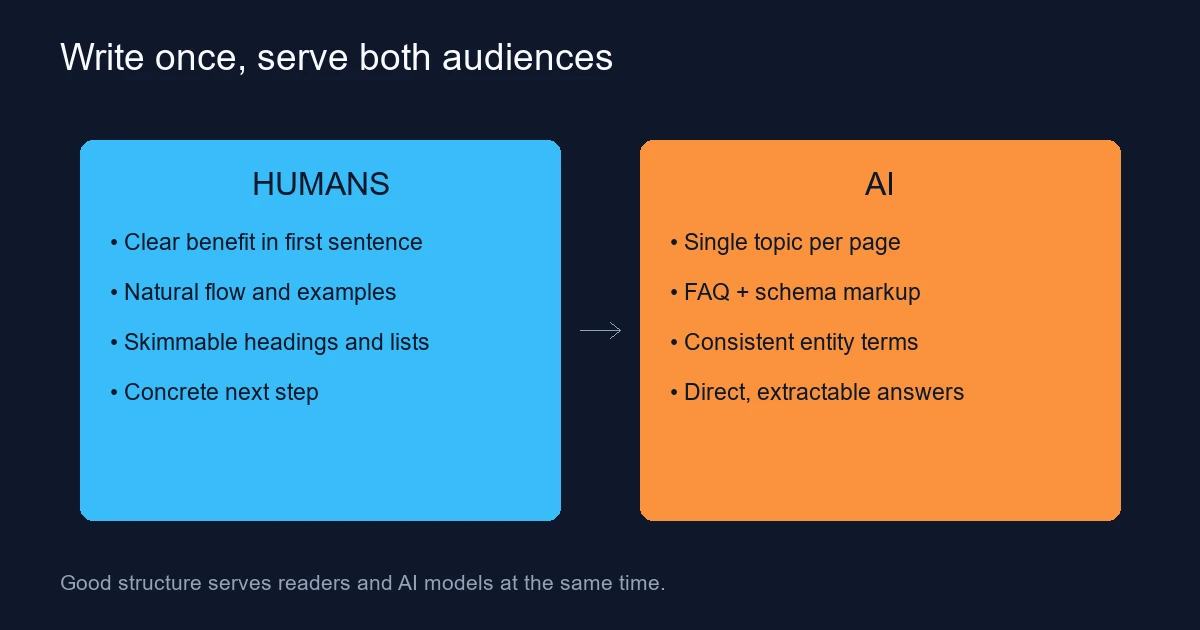
One of the most common conflicts in modern web writing is the question: do we write for humans or for machines? The good news is that you no longer have to choose. Good writing can satisfy both — if you know how to structure it.
The goal is not to “trick” an algorithm. The goal is to write clearly and usefully in a way that humans want to read and AI models can accurately understand.
Principle 1: Answer first, then develop
Answer-first format is key. If the reader is looking for an answer, do not keep them in suspense until the third paragraph. The first sentence should be the direct answer. Then come details, examples, and context.
This also helps AI models, which often extract answers from the first sentence of a paragraph.
Principle 2: Use clear headings as signposts
H2 and H3 headings are not just SEO elements. They are a map of the text. A good heading should say what follows. Example: “How FAQPage schema helps AI models” is better than “Another important thing.”
Principle 3: Write concretely, not generally
Compare these two paragraphs:
“We offer complete digital solutions for various clients.”
“MaxDesign builds custom web systems in Laravel for B2B companies in Serbia and Europe, with a focus on SEO, AEO, and GEO architecture.”
The second paragraph gives AI models concrete entities: Laravel, B2B, Serbia, Europe, SEO, AEO, GEO. The first gives nothing.
Principle 4: Use lists and tables where they help
AI models love structured formats. Lists, tables, and step-by-step explanations are easier to extract than long blocks of text. But do not force the format — use it when it genuinely helps the reader.
Principle 5: FAQ is a powerful format
FAQ sections are ideal for writing that serves both humans and AI models. Each question has a clear answer, and schema markup further helps machines recognize them.
Principle 6: Be consistent in terminology
If in one paragraph you use “website design,” in another “web development,” and in a third “site building,” an AI model may conclude you are talking about different things. Choose primary terminology and use it consistently.
Principle 7: Add context and examples
AI models can recognize facts, but humans want examples. Good content combines concrete examples with clear general principles. This satisfies both “audiences.”
Conclusion
Writing that serves both humans and AI models is not a technical skill. It is the skill of clear communication. When you know what you want to say and structure it logically, both “audiences” will be satisfied.
Example text transformation
Imagine you are writing about website design pricing. A weak version reads:
“Website design pricing depends on many factors. Contact us for a quote.”
A better version, suitable for both humans and AI, reads:
“MaxDesign website design starts at EUR 1,500 for a B2B presentation site built in Laravel. Price depends on the number of pages, functionality, and level of SEO / AEO / GEO preparation. Send a brief for an exact quote.”
The second version gives a concrete number, technology, segment, and next step. An AI model can extract the price and context, and the reader gets an answer without extra effort.
How to structure a paragraph for AI extraction
- The first sentence should be the direct answer.
- The second sentence adds context.
- The third sentence gives an example or exception.
- The closing sentence calls to action or links to a related topic.
Common writing mistakes
- Keyword stuffing. Harms both humans and AI models.
- Long introductions without answers. Reader and AI lose patience.
- Inconsistent terminology. “Website design,” “web development,” and “site building” may be treated as different services.
- Lack of examples. Abstract text is harder to remember and cite.
Exercise: write one page
- Choose one service you offer.
- Write an H1 that clearly states what the page is about.
- In the first two paragraphs answer “what, for whom, why.”
- Add three H2 sections with concrete examples.
- Finish with a five-question FAQ and a clear CTA.
What to review before publishing
Before any page goes live, run a short review focused on both audiences. For humans, check tone, clarity, and usefulness. For AI, check headings, first sentences, schema markup, and consistent terminology. Ask a colleague to read the page without knowing the topic: if they can summarize it in one sentence, the page is probably well structured. If they struggle, AI will struggle too. A five-minute human review often catches issues that automated tools miss, such as awkward phrasing, mixed messages, or missing context.
Balancing tone and structure
Good web content must sound natural when read by a human, but also be structured enough for AI models to parse. This means using clear headings, short paragraphs, and concrete examples, but without making the text feel robotic. If every paragraph starts with the same phrase or if headings read like a checklist with no personality, people will stop reading.
One good test: read the text out loud. If it sounds like something you would say to a client in a meeting, the tone is right. If it sounds like generated content, it needs refining.
Example: a service pricing page
A weak version: "The price of our services depends on many factors. Contact us for more information." This gives nothing to humans or AI models.
A better version: "Custom Laravel website development at MaxDesign starts at EUR 2,500 for a B2B presentation site with up to ten pages. The price increases with the number of integrations, the level of SEO / AEO / GEO preparation, and design requirements. Send a brief for an exact quote." This gives a concrete number, segment, technology, and next step.
Using examples from the Serbian market
When writing for the Serbian market, use examples people understand: a Belgrade company wanting to appear in ChatGPT, a Niš beauty salon wanting local visibility, a Novi Sad law firm wanting to be recognized as an expert in labor law. These examples make the text more relevant and help AI models connect your brand with specific locations and industries.
For more on writing helpful content, see Google Search Central — Creating helpful content and Nielsen Norman Group — Writing for the Web.
Avoiding over-optimization
There is a fine line between writing for humans and writing for AI. Over-optimization leads to keyword-stuffed text, repeated phrases, and unnatural flow. Such text harms both humans and AI models. The rule is simple: write a clear, useful text first, then refine it to be more structured.
Frequently asked questions
Should keywords be forced into content for AI SEO?
No. Keyword stuffing harms both humans and AI models. Use keywords naturally, in context.
Do AI models prefer shorter text?
AI models like clarity, not necessarily brevity. Long text is fine if it is well structured and every section has a purpose.
Should content for the Serbian market be written in English or Serbian?
It depends on your market. If you target Serbia, write in Serbian. If you target international markets, write in English.
Which part of the text matters most for AI answer extraction?
The first sentence of a paragraph, headings, and FAQ sections are key. AI models often extract answers from these parts.
Is it acceptable to use an AI tool to write website content?
You can, but a human with experience must review it. AI is a tool for acceleration, not a replacement for expertise. More in the article AI Does Not Replace Experience. It Multiplies It.
Further reading
- AEO services — answer-first approach.
- Content systems — content organization.
- Google — Creating helpful content
- Nielsen Norman Group — Writing for the Web — additional authoritative source.
- schema.org — additional authoritative source.
Want to improve your website content?Schedule a consultation.


